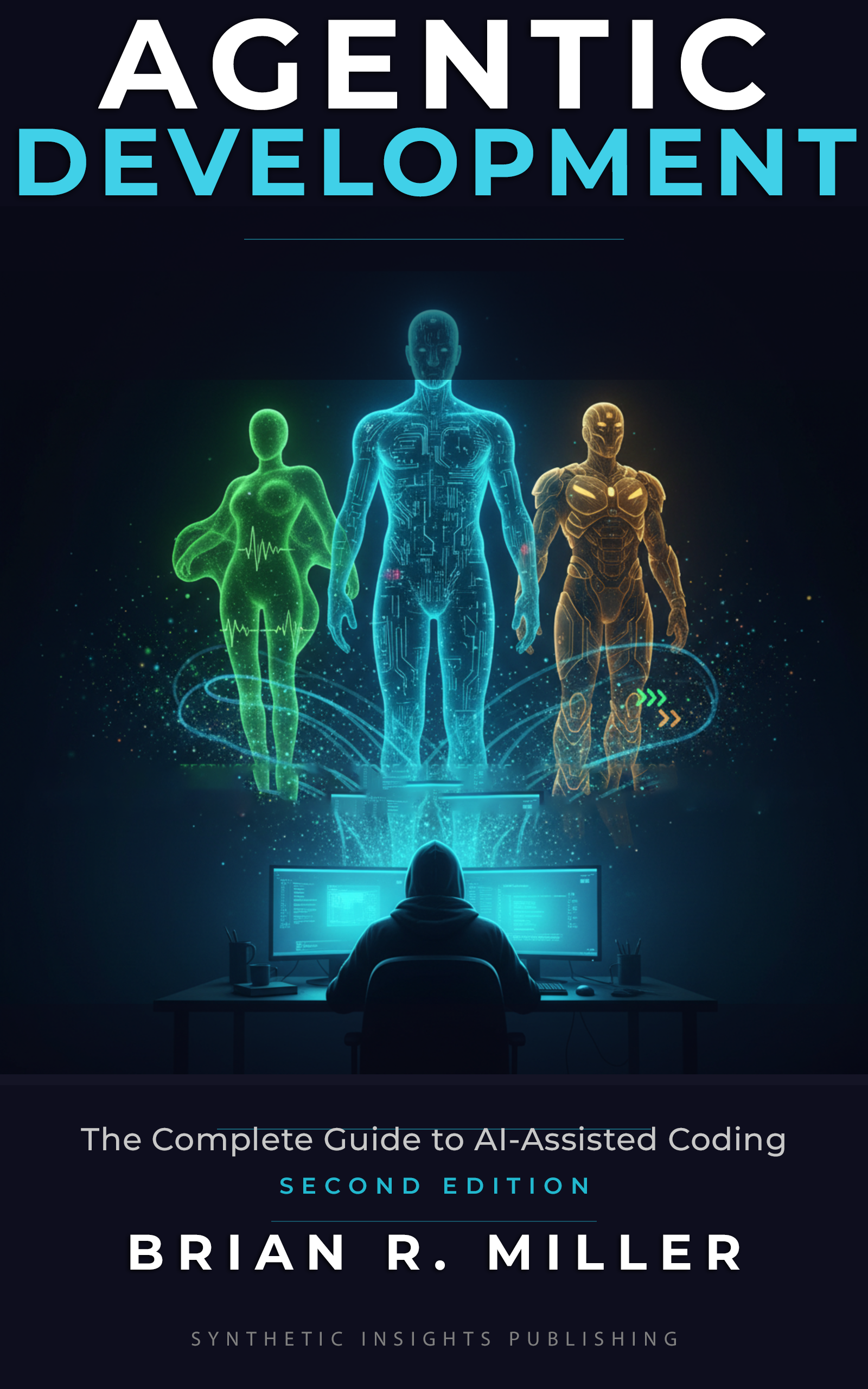
Agentic Development Book Cover
Second Edition

Agentic Development

The Complete Guide to AI-Assisted Coding with Claude, Cursor, and Beyond

The definitive guide to AI-assisted software development. From your first AI coding session to architecting complex multi-agent systems, this book provides practical frameworks for 10x productivity.

596 Pages
18 Chapters
5 Parts
86K+ Words

Choose Your Edition

📱

Kindle eBook

Digital • Instant delivery

Read on any device

Buy Kindle
📚

Hardcover

596 pages • 6" × 9"

ISBN: 979-8-9946737-2-0

Buy Hardcover

Master AI-Assisted Development

🎯

Effective Prompting

Learn the art of crafting prompts that get results. From simple queries to complex multi-turn conversations with AI assistants.

🧠

Context Management

Master the techniques for maintaining project context across sessions. Build systems that help AI understand your codebase deeply.

🔄

Development Workflows

Integrate AI assistants into every phase: planning, coding, debugging, testing, and documentation. Real workflows that actually work.

🤖

Multi-Agent Patterns

Coordinate multiple AI agents for complex tasks. Learn orchestration patterns used in production systems.

🔐

Security Best Practices

Keep your code secure while using AI. Understand the risks and implement proper safeguards for production systems.

📈

Team Collaboration

Scale AI-assisted development across teams. Establish standards, share contexts, and maintain quality at scale.

Table of Contents

Part I: Foundations

Getting started with AI-assisted development

  • Chapter 1: The Agentic Revolution
  • Chapter 2: Setting Up Your Environment
  • Chapter 3: Your First AI-Assisted Project
  • Chapter 4: Understanding AI Capabilities

Part II: Core Workflows

Day-to-day development with AI

  • Chapter 5: The Development Cycle
  • Chapter 6: Debugging with AI
  • Chapter 7: Testing Strategies
  • Chapter 8: Documentation & Knowledge

Part III: Advanced Techniques

Scaling up your AI workflows

  • Chapter 9: Complex Project Management
  • Chapter 10: Context Architecture
  • Chapter 11: Team Collaboration
  • Chapter 12: Multi-Project Coordination

Part IV: Expert Practices

Production-grade AI development

  • Chapter 13: Security Considerations
  • Chapter 14: Performance Optimization
  • Chapter 15: Production Deployment

Part V: Reference

Quick reference and resources

  • Chapter 16: Prompt Library
  • Chapter 17: Troubleshooting Guide
  • Chapter 18: Future Directions
  • Appendices A-E

Companion Materials

Get the most out of your book with these free resources

Everything You Need to Get Started

The companion repository includes production-ready templates, scripts, prompts, and checklists that transform the book's concepts into immediate action.

  • Templates: CLAUDE.md, SESSION_STATE.md, Cursor rules, and more
  • Scripts: Environment setup, session management, quality gates
  • Prompts: Ready-to-use prompts for coding, debugging, testing, documentation
  • Checklists: Environment setup, code review, deployment verification
Get Resources on GitHub
CLAUDE.md
# Project Context

## Overview
This project uses agentic development
practices with Claude Code.

## Key Files
- src/           # Source code
- tests/         # Test suites
- docs/          # Documentation

## Development Workflow
1. Read context at session start
2. Update context during work
3. Save state at session end

Brian R. Miller

Brian Miller is a Technology and Cybersecurity professional dedicated to building AI systems that prioritize user privacy and sovereignty.

With extensive experience in software architecture, AI systems, and product development, Brian has spent years exploring the intersection of human creativity and artificial intelligence. His work on the Athena Ecosystem and ARIA represents a new approach to AI assistants—one that treats users as partners rather than data sources.

"Agentic Development" draws on hundreds of hours of real-world experience building production systems with AI assistance, offering practical guidance for developers at all levels who want to leverage AI tools effectively while maintaining engineering excellence.

Not Just Another AI Book

🎯

Practical Focus

No theoretical fluff. Every chapter provides actionable techniques you can apply immediately to your development workflow.

🔧

Tool-Agnostic

While featuring examples from Claude Code and Cursor, the principles apply regardless of which AI assistant you use.

📈

Progressive Depth

Start with fundamentals and progress to advanced multi-agent patterns. Suitable for beginners and experts alike.

Quality-First

Emphasizes maintaining code quality, security, and engineering excellence—not just shipping fast.

Sample Chapter

Get a taste of the book with this excerpt from Chapter 1

Chapter 1: The Agentic Revolution

The way we build software is changing. Not incrementally, not gradually, but fundamentally. AI coding assistants have evolved from simple autocomplete tools into sophisticated partners capable of understanding complex codebases, generating production-quality code, and maintaining context across entire development sessions.

This isn't about replacing developers. It's about amplifying human creativity and capability. The best AI-assisted development happens when humans and AI work together, each contributing their unique strengths: humans providing vision, judgment, and domain expertise; AI providing speed, pattern recognition, and tireless attention to detail.

In this book, you'll learn to harness this partnership effectively. We'll start with the fundamentals and progress to advanced techniques, always grounded in practical, real-world examples. By the end, you'll have the skills to transform your development workflow and achieve productivity gains you might not have thought possible.

Continue reading in the full book...

What Readers Are Saying

Reviews coming soon! Be among the first to share your experience with Agentic Development.

Leave a review on Amazon

Frequently Asked Questions

What AI tools does this book cover?

The book primarily features examples using Claude Code and Cursor, but the principles and patterns apply to any AI coding assistant including GitHub Copilot, Amazon CodeWhisperer, and others. The focus is on transferable skills that work across tools.

Do I need prior AI experience?

No. The book starts with foundational concepts and progressively builds to advanced techniques. Part I covers everything you need to get started, even if you've never used an AI coding assistant before.

What programming languages are covered?

The patterns and techniques are language-agnostic. Examples include Python, JavaScript/TypeScript, and others, but the concepts apply to any programming language supported by modern AI assistants.

Is there a digital/ebook version?

Yes! The book is available as a Kindle eBook for instant digital delivery, as well as in paperback and hardcover formats. All versions contain the same complete content.

Are the companion resources really free?

Yes. The companion GitHub repository is completely free and includes all templates, scripts, prompts, and checklists mentioned in the book. No signup required.

How do I report errors or suggest improvements?

Please submit issues to our GitHub repository or email athena@synthetic-insights.ai. We maintain an errata list and incorporate feedback into future editions.

Errata & Updates

We strive for accuracy, but errors occasionally slip through. This section tracks known issues and corrections for the second edition.

Current Status

No errata reported for the second edition. Last checked: February 13, 2026.

Report an Issue

Found an error? Please let us know:

Please include the page number, edition (check copyright page), and a description of the issue.

Ready to Transform Your Development Workflow?

Join developers who are already using agentic development to build better software faster.